Viet Hai is a farming valley of 87 households and about 295 people on the far side of Cat Ba Island, inside the national park, and no road links it to the rest of the island. You arrive by speedboat from Ben Beo harbour in about 15 minutes or on foot across the park in four to five hours; the last 3.4 km from the pier is a lane through a tunnel in the hill. Visitors describe it as car-free. That is not quite what it is, and the true story — tenant farmers in 1930, oil lamps until 2009, a radar station bombed on the ridge above — is better than the label. Our family runs a homestay here; this is what we tell guests.
| Where | Viet Hai village, Cat Ba Island, Cat Hai Special Zone, Hai Phong — the eastern side of the island, on the shore of Lan Ha Bay, surrounded by Cat Ba National Park |
| Size | A valley about 1.3 km long and 300 m wide inside a village area of 6,485 ha; 87 households, about 295 people (2025) |
| Access | No road link. Speedboat from Ben Beo about 15 minutes, then 3.4 km by electric cart (about 10 minutes); or the trek across the park, 9–12 km, 4–5 hours |
| Founded | Forest cleared for fields around 1930; named Viet Hai in 1959; mains electricity since 16 August 2009 |
| Status | Inside the Ha Long Bay–Cat Ba Archipelago World Heritage area; recognised as Hai Phong’s 13th community tourism site in June 2025 |
| Fixed fees | Lan Ha Bay ticket 120,000 VND adult / 60,000 VND child (free under 6 or under 1.2 m); electric cart 50,000 VND per person; bicycle hire 30,000 VND per day; Ninh Tiep–Tien Duc cave route 80,000 VND adult / 40,000 VND child |
| Best months | October–November, then March–April; the fish stream is liveliest July–September |
On this page: Why no road reaches it · History · The valley today · Things to do · A full day, hour by hour · How to get there · Where to stay and dinner · What guests say · Best time · Practical notes · FAQ
Where is Viet Hai, and why does no road reach it?
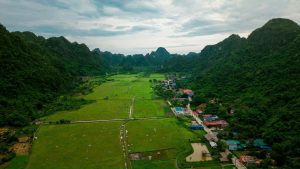
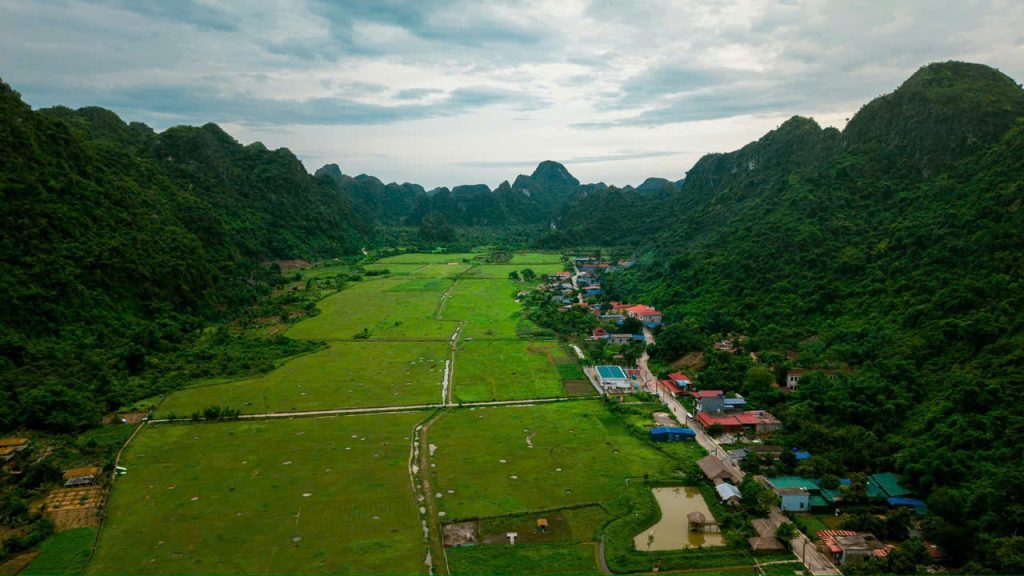
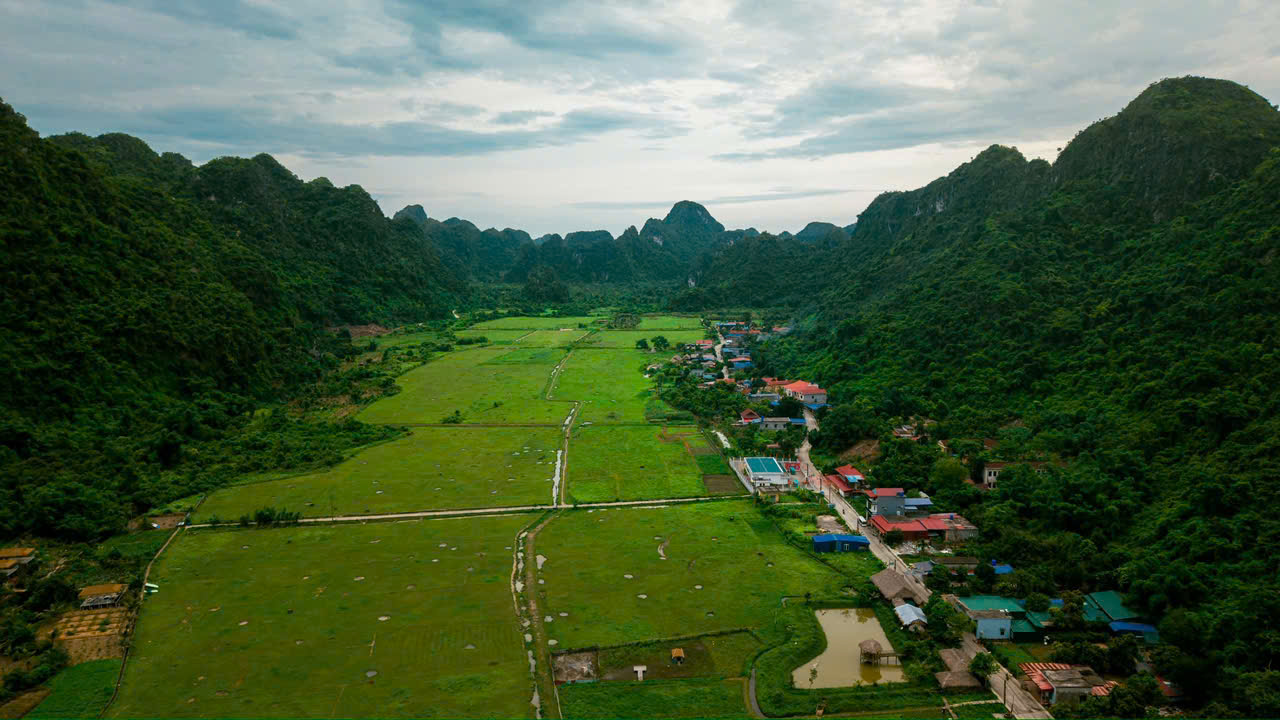
Viet Hai sits on the eastern side of Cat Ba Island facing Lan Ha Bay, with the national park on every other side. The valley — the old Tai Lai valley — is about 1.3 km long and on average 300 m wide, a strip of rice and vegetable land walled in by limestone; the village area recorded in 2025 is 6,485 hectares, nearly all of it forest and water. The pier is on the bay. The village is about 3.4 km inland, up a concrete lane that passes through a tunnel cut in the hill.
The reason there is no road is the rock. Cat Ba’s interior is a block of karst ridges and closed valleys, and the island’s road stops at the national park headquarters, some 14 km from the Viet Hai pier as the trail runs. The village’s own written history records that it was the only one of the old district’s twelve communes and towns with no vehicle road from the district centre — geography, not policy. Nobody banned cars. There was never a way to bring them in.
So “car-free” needs a footnote. Around 2020 the same document counted 16 passenger vehicles and close to 50 motorbikes in the village; the electric carts that meet the boats are part of that fleet. What you notice is that nothing passes through: every vehicle starts and ends its journey in the valley, and most people cycle. A green transition plan for 2025–2030 — electric transport, solar power, less single-use plastic, organic farming — is under way, but no ban has been published.
A short history of the valley: 6,500 years in three layers
Blogs call Viet Hai an ancient village. The village is not ancient; the valley is. Three separate periods overlap here, and it helps to keep them apart.
Around 6,500 years ago: the caves
Two caves within the village boundary, Tien Duc and Ang Giua, hold traces of people who lived here roughly 6,500 years ago: bones, and thick layers of shell left by people who gathered shellfish on the tidal flats and hunted in the forest. It is the same Neolithic world as Cai Beo, the 7,000-year-old site 1.5 km from Cat Ba town.
1885–1889: the rebel leader who gave a cave its name
Between 1885 and 1889 an anti-French uprising led by Doc Tit and Tien Duc held out in the broken country of Trung Trang, Mai Go, Tra Bau and Viet Hai. After a large battle in 1889, outnumbered, Tien Duc withdrew into the Viet Hai valley and then left Cat Ba. The cave that carries his name is still within the village boundary, and it is one of the walks we send guests on.
1930 to today: the farmers
The village itself dates from about 1930. According to the history compiled from the records of the local Party cell, two men of Chinese origin, Ly Gia Nhan and Mac Tac Kham, came from Hoanh Bo in Quang Ninh with ten tenant farmers and cleared the forest at Tai Lai, Ninh Tiep and Ang Vong into fields. Tai Lai then had 12 households, Tra Bau 3 and Ang Vong 1, and the record describes life as “very hard, mostly self-sufficient”. They grew rice, kept animals and took what the forest and the tidal flats gave — farmers from the first day, which is why “fishing village” is wrong. The families who fished were a separate group who later moved out onto the bay.
The valley then changed hands several times. The Chinese families left in 1947–48, unsettled by what the record calls bad omens, leaving their houses and two plough buffalo. Households from Hai Duong, Hoang Chau and Pha Le moved in, then families from the wartime resistance bases after Viet Hung commune was formed in November 1949 — renamed Viet Hai in 1959 — then about 20 settler families from Trang Cat in November 1963. Today’s villagers descend from all of these — tenant farmers, wartime evacuees and 1960s settlers — about three generations deep.
Two more dates matter. In 1965 the navy built a radar station on the 259 m summit above the village, Navy Peak, with villagers helping to build it; after repeated American bombing the equipment was moved in 1968 to a new site by Tung Gau bay. And on 16 August 2009 the national grid reached Viet Hai along a line run through the forest from Hai Son hamlet. Until then the valley lit itself with oil lamps; some of the people who run homestays here today grew up without mains electricity.
The name is the last correction. Viet Hai is an administrative name from 1959; the valley was Tai Lai, and its two remaining hamlets are now simply Hamlet 1 and Hamlet 2. The story that the name means “Vietnamese Sea” and was given by ancient fishermen appears on many English-language sites; no document supports it.
| When | What happened in the valley |
|---|---|
| c. 4500 BC | People living in Tien Duc and Ang Giua caves, gathering shellfish on the tidal flats |
| Mid-18th century | Nguyen Huu Cau’s rising uses Cat Ba and the Viet Hai area as a supply base |
| 1885–1889 | Doc Tit and Tien Duc’s uprising against the French; Tien Duc retreats into the valley after the 1889 battle |
| c. 1930 | Two landowners from Hoanh Bo and ten tenant farmers clear Tai Lai, Ninh Tiep and Ang Vong for fields |
| 1947–1948 | Chinese families leave; houses and two buffalo left behind; new families from Hai Duong, Hoang Chau, Pha Le |
| November 1949 | Viet Hung commune formed from Tra Bau and Tai Lai |
| 1959 | Renamed Viet Hai |
| November 1963 | About 20 families settle from Trang Cat |
| 1965–1968 | Naval radar station on the 259 m peak; moved after bombing |
| 2005–2011 | Primary school, reservoir, pier, cultural house and a 1.5 km tourist lane built |
| 16 August 2009 | Mains electricity arrives |
| 19 June 2025 | Recognised as Hai Phong’s 13th community tourism site (announced 14 August 2025) |
| 1 July 2025 | Becomes part of the Cat Hai Special Zone of Hai Phong |

The valley today: 87 households, rice, and a lane through a tunnel
Viet Hai in 2025 counts 87 households and about 295 people in two hamlets. It remains a farming village — rice on the valley floor, vegetables, chickens and pigs, some fishing and fish farming in the bay — with community tourism growing alongside. Around 2020 the village counted 6 homestays with 45 rooms, around 10 places to eat and more than 500 bicycles for hire. There is a primary school, a cultural house, a reservoir and the pier, all built between 2005 and 2011, but no communal house, pagoda or festival of the village’s own; a community assembled from so many places in ninety years has not had time to grow one.
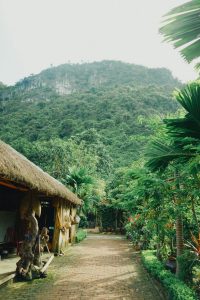
Houses tell the economic story. For most of the village’s history they were built from what grew in the valley — mud, thatch grass, bamboo, timber, straw — because with no road there was no way to bring in brick or cement. Only a handful of better-off families could afford stone walls and roof tiles, so the few old stone houses you pass are a mark of wealth, not a regional style. Brick and cement came later, with the money, at about the same time as the electricity and the visitors.
Visitor numbers grew fast before the pandemic: about 17,000 in 2017, 25,000 in 2018 and 45,000 in 2019, roughly 90% of them international. Most came on a day boat, cycled the lane for under an hour and left, which is why average spending in the village was recorded at only 100,000–150,000 VND a head. We say this plainly because it is the case for staying: the valley between four in the afternoon and nine the next morning — dinner at one table, a dark sky, mist on the rice at first light — is the part day visitors never see.

Things to do in Viet Hai village
Cycle the valley road
The village road is about 1.6 km end to end, flat and concrete, with side lanes to the fields, the fish stream and the trailheads; the lane to the pier adds 3.4 km each way through the tunnel. An hour covers it, a morning lets you stop and talk. Bicycles are 30,000 VND a day, free only for guests on our 3-day, 2-night tour; the loops are mapped in cycling in Viet Hai village.
Put your feet in the fish stream
A stream at the north-eastern end of the village where small fish nibble the dead skin from your feet. Free, a short ride from the centre, and best from July to September, when the village history notes there are many more fish. In winter the water is cold and the fish are few.
Walk to Tien Duc cave
The Ninh Tiep stream–Tien Duc cave route is the national park’s trail on the village side: 45 to 60 minutes through forest, park fee 80,000 VND per adult and 40,000 VND per child. You are walking to the cave named for the rebel leader of 1889 and to one of the two caves people lived in 6,500 years ago. Keen walkers can continue past Ao Ech, the 3.2 ha freshwater swamp forest, to the park headquarters in about 2.5 hours more.
Climb Navy Peak
Navy Peak — Hai Quan, 259 m — rises directly above the village, a different hill from Ngu Lam near park headquarters. Allow about three hours return; the upper section is bare limestone and a guide is worth having. The summit is the site of the 1965 radar station, and the view runs 360° over the valley, Lan Ha Bay and the southern islands of Ha Long. We guide the Navy Peak hike from the homestay, leaving early to beat the heat.
Kayak from the pier
The pier is on the bay, so a kayak leaves from where the speedboat lands. Ang Vong and Cai Minh Tu, two coves within the village’s water, make the natural half-day paddle in calm water inside the islands. For a full day, our full-day Lan Ha Bay boat tour leaves from the village side and reaches Bright and Dark cave before or after the town boats, with kayaking, swimming, lunch on board and a family fish farm.
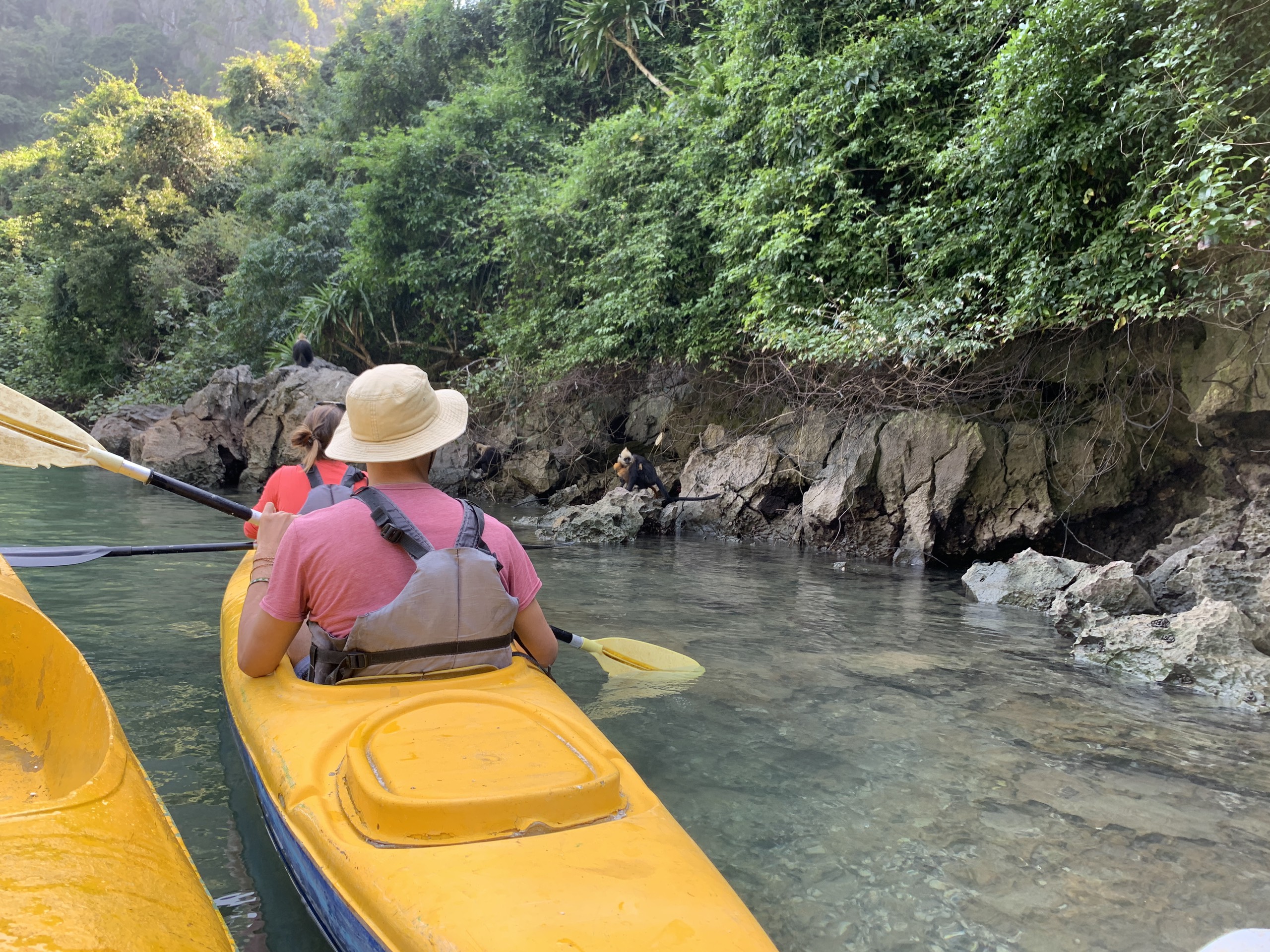
Paddle after dark
From May to September, on the darkest nights of the lunar month, the water on our side of the bay lights up around the paddle with bioluminescent plankton. We run sunset and night kayaking on those nights only, planned by the moon rather than the clock.
Walk in across the national park
The most memorable way to arrive is on foot: from park headquarters over the ridge, past Ao Ech and down into the valley — 9 to 12 km depending on the route, four to five hours, humid and steep in places. You will meet macaques and birds, not langurs; the langur lives on the coastal cliffs and is seen from the water, if at all. Your bag goes ahead by boat for 350,000 VND. The route is in the trek across Cat Ba National Park to Viet Hai.
The Navy Peak hike leaves from our gate with a guide, water and the radar-station story, about three hours door to door. Guests with three days take the 3-day cruise and homestay: a night at anchor on Lan Ha Bay, a cooking class, then the village and the peak. Rates move with the season and group size — ask us for the current one.
A full day in Viet Hai, hour by hour
This is the day we build for guests who arrive the afternoon before and leave the next afternoon. Swap Navy Peak for the Tien Duc walk for an easier morning. A one-night version is in one day in Viet Hai village.
| Time | What | Notes |
|---|---|---|
| 06:00 | Walk or cycle the valley road before breakfast | Mist on the rice fields, the village at work; a jumper from December to February |
| 07:30 | Breakfast at the homestay | Included in the room |
| 08:30 | Navy Peak, 259 m | About 3 hours return with a guide; proper shoes, a litre of water each |
| 11:30 | Back in the garden | Shower, hammock, nothing |
| 12:30 | Lunch | Quick-food menu, about 20 minutes’ notice |
| 14:00 | Cycle to the fish stream | North-eastern end of the village; most fish July–September |
| 15:30 | Electric cart to the pier, kayak to Ang Vong cove | Cart 50,000 VND per person; calm water inside the islands |
| 17:30 | Sunset from the pier or the fields | Earlier in winter, later in summer |
| 19:00 | Dinner at one long table | Seafood hotpot or barbecue needs a day’s notice |
| 20:30 | Night kayaking in season, or the lane in the dark | May–September, darkest nights of the lunar month only; head torch |
| Next day, 09:00 | Cart to the pier, speedboat to Ben Beo | About 10 minutes plus about 15 minutes; bags carried on and off by hand |
How to get to Viet Hai village
Every route ends at the pier on Lan Ha Bay or on the trail down from the ridge. From Cat Ba town the way is Ben Beo harbour, a speedboat of about 15 minutes across the bay, then the electric cart for the 3.4 km lane — about 10 minutes, 50,000 VND per person. The Lan Ha Bay ticket, 120,000 VND per adult and 60,000 VND per child (free under six or under 1.2 m), is collected on every crossing. Ben Beo has no ticket office and no timetable; boats are arranged, not scheduled, so fix the crossing a day ahead.
| Way in | Time | What it involves | Best for |
|---|---|---|---|
| Speedboat from Ben Beo | About 15 minutes, plus 10 minutes by cart | Direct crossing arranged in advance; bay ticket and cart fee in cash | Luggage, families, anyone short of time |
| Full-day boat tour ending at the pier | A full day | Kayaking, swimming, lunch on board, then landed at the village in the afternoon | Most of our guests — the crossing becomes the trip |
| Trek across the national park | 4–5 hours, 9–12 km | From park headquarters over the ridge past Ao Ech; park fee; bag sent ahead by boat for 350,000 VND | Walkers arriving with a day in hand |
| Overnight cruise | One night on the water | Some itineraries stop at the mouth of the valley; cross-bay routes from Ha Long licensed since 20 April 2026 | Combining a cruise with a village night |
| Door-to-door transfer | 3–3.5 hours Hanoi to Cat Ba, then the boat | Bus or car to Dong Bai pier, ferry to Cai Vieng, road to Ben Beo, speedboat and cart, tickets included | Anyone who wants it handled |
The mainland side changed in 2026: the old Got pier is closed to tourist traffic, and every crossing from Hai Phong now leaves from Dong Bai pier for Cai Vieng wharf on Cat Ba — about 15 minutes by car ferry, under ten by passenger speedboat. From Hanoi allow 3 to 3.5 hours to Cat Ba town. Every option is compared in how to get to Viet Hai village.

Our signature trip is 2 Days in Viet Hai, Hanoi to Hanoi: pick-up in the Old Quarter, a full-day Lan Ha Bay boat tour with kayaking and swimming that lands you at our pier in the afternoon, the night in the valley, and the return the next day, every ticket and transfer included. Rates move with the season and group size — ask us for the current one.
Where to stay in Viet Hai, and what dinner is like
A handful of family homestays share the valley — six with 45 rooms between them at the 2020 count. Ours, Lan Homestay, has 15 rooms: garden bungalows and mountain-view rooms with private bathrooms and hot water, breakfast included, bicycles for hire, check-in from 11:30 to 13:00; small pets by arrangement — tell us when you book and bring your dog’s own bed or crate. Rates move with the season and group size; ask us for the current one.
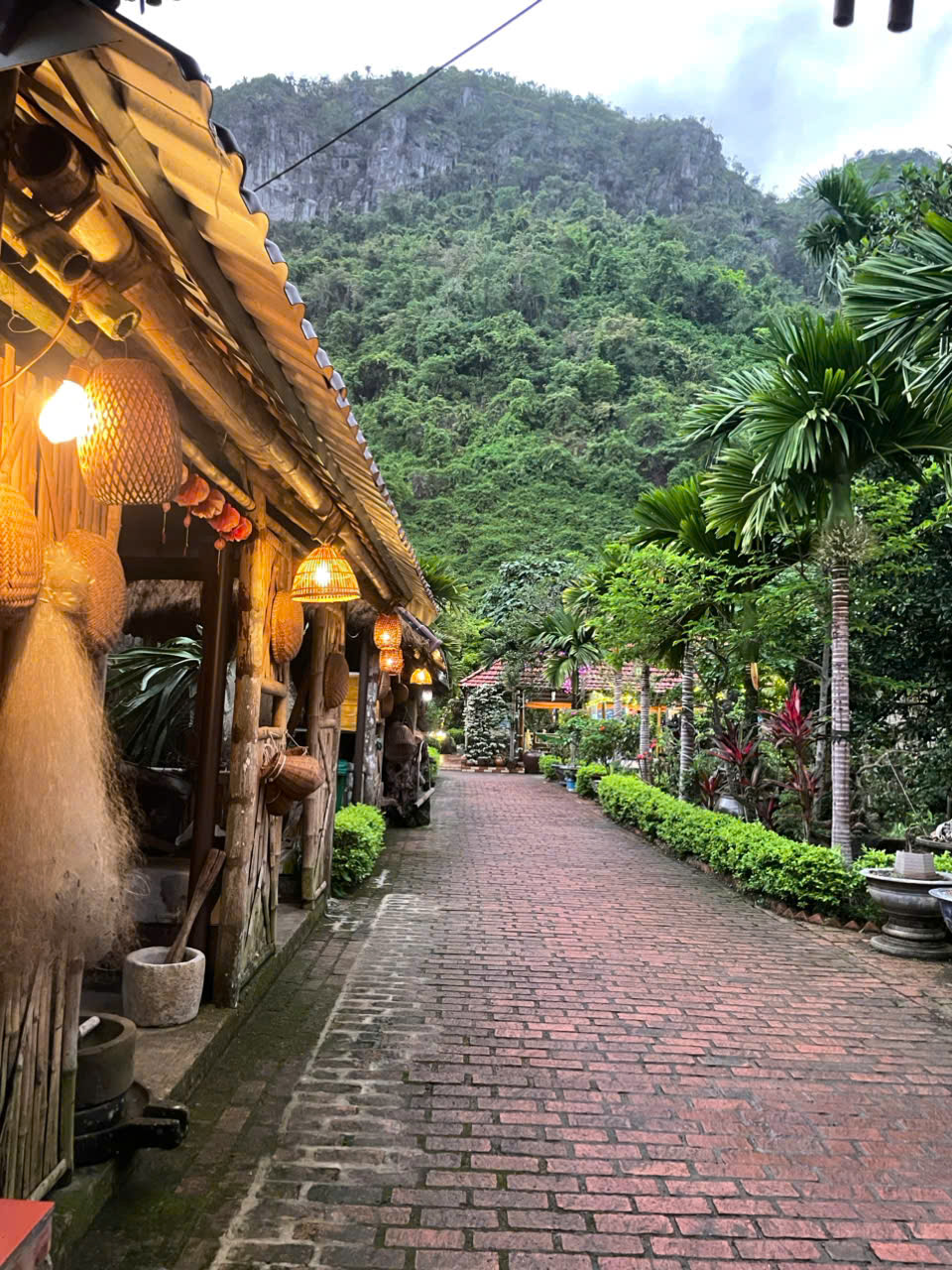
Dinner is the point of the night. It is served at one long table, everyone staying eats together, and the food is Northern farmhouse cooking plus what the bay sends over: free-range chicken with ginger, boiled chicken, fish soup, crisp-fried dried fish, garden greens, valley rice, and a glass of banana or honey wine if you want one. Seafood hotpot or barbecue — clams, sea snails, red snapper, in season sea urchin — needs a day’s notice; the quick-food menu takes about 20 minutes. None of it is a “traditional Viet Hai dish”; it is what a farming family in this valley eats, cooked by ours. A typical evening is in what to eat in Viet Hai village.
What guests say about Viet Hai and Lan Homestay
At the time of writing, early 2026, Lan Homestay is rated 4.8 out of 5 on TripAdvisor from 304 reviews and ranks third of 98 places to stay in Cat Ba. These five are typical of what people notice.
“There’s no question that this little homestay was the pinnacle of our honeymoon! … a stunning place nestled right in the village of Viet Hai and Cat Ba national park jungle. Chilly and the team really made our honeymoon special.”
— wspkkirk, Kingston-upon-Hull, UK, October 2025
“Our family recently returned to Lan Homestay — my wife and I first stayed in 2017 … Every home-cooked meal was fresh, abundant, and delicious … Chilly and Hai made us feel like family, not guests.”
— Jesus G, New York City, October 2025
“Arriving by speedboat to the little harbour as the full moon rose is a memory I will not forget. The day boat tour is well worth doing. And the climb up Navy Mountain is challenging but the view from the top is spectacular.”
— JaneEagle, February 2026
“They take care of booking the travel there and back. We chose the trek through the national park and it was amazing! A tough trek but worth it … A little piece of quiet paradise.”
— Jeanne F, December 2025
“The place is amazing in the middle of nature. The excursions offered are on a human scale and large tourist cruises are avoided.”
— Sophie R, Bordeaux, January 2026

When is the best time to visit Viet Hai?
Hot, wet summers with typhoons; cool, misty winters. October and November are the best months all round, March and April a close second. July to September is the season for the fish stream and the plankton, but also for storm warnings that close the bay. The month-by-month reasoning is in best time to visit Cat Ba.
| Months | Weather | In the village |
|---|---|---|
| October–November | Warm and dry, clear air, sea 25–27°C | The best of the year: cycling, Navy Peak and the bay all work; thin crowds |
| March–April | Warming, morning mist, sea 21–25°C | Very good; misty dawns over the fields; book ahead around the 30 April holiday |
| December–February | Cool, 15–20°C on many days, grey sky, sea 18–21°C | Empty and quiet; walking and cycling weather, not swimming; bring layers; Tet fills the island for a week |
| May–September | Hot, sea 28–30°C, afternoon storms, typhoons | Fish stream at its liveliest July–September; plankton on moonless nights; keep a spare half-day for bay closures |
Practical notes for Viet Hai
- Cash. No ATM in the village, and many local places cannot take international cards. Withdraw in Cat Ba town; the bay ticket, park fees and the cart are cash only. At the homestay we accept VND, US dollars, euros and cards; from 1 January 2026 every bill carries 7% tax and cards a further 3% bank fee — see our payment information page.
- Luggage. Bags are carried on and off speedboats by hand. Pack light; if you trek in, the bag boat is 350,000 VND.
- Packing. Shoes you can walk and get wet in, a light rain layer, a head torch, insect repellent, swimwear, a warm layer from December to February. The full list is in what to pack for Cat Ba.
- Signal. Patchy in the valley; the homestay has Wi-Fi.
- Weather. No boat sails under a storm warning. If the bay closes you stay another night; in summer, plan for it.
- Fields and animals. Do not feed the macaques, keep to the lanes through the rice, and take your plastic back to town.
- Time. Day boats give the village about forty minutes. One night shows you why people stay; two let you climb the peak and spend a day on the water.
Frequently asked questions about Viet Hai village
Answered by the Lan family in Viet Hai — the people who run the boats, cook the dinner and pick you up at the pier.
Is Viet Hai village worth visiting?
Yes, if you stay the night; less so as a forty-minute stop from a day boat. The lane, the fish stream and the fields can be seen in an hour, but the reason people remember the place is the evening and the early morning, when the boats have gone and 295 people have the valley to themselves. Give it one night at least.
Is Viet Hai really car-free?
Not by law. No road links the valley to the rest of Cat Ba, so nothing drives in or out; the few vehicles that exist — around 16 passenger vehicles and about 50 motorbikes at the last count, plus the electric carts — stay inside the valley. Most people cycle. “Car-free” is how visitors describe it, and the feeling is real, but it is geography, not regulation.
How many days do you need in Viet Hai?
One night is the minimum that makes sense, arriving by boat in the afternoon and leaving the next morning or afternoon. Two nights let you climb Navy Peak, spend a full day on Lan Ha Bay and still have an unhurried morning in the fields. Walkers who trek in usually want two nights to recover and see the bay.
How do I get to Viet Hai village from Hanoi?
Bus or car to Dong Bai pier and the ferry to Cat Ba, 3 to 3.5 hours to Cat Ba town; then Ben Beo harbour, a speedboat of about 15 minutes across the bay, and the electric cart for the last 3.4 km. Boats at Ben Beo are arranged, not scheduled, so book the crossing a day ahead or have us handle the whole route from your Hanoi hotel.
Is Viet Hai suitable for children and older travellers?
Yes. The valley is flat, the road is concrete, the bicycles come in all sizes and the cart does the hill from the pier. The homestay has ground-floor bungalows. Only Navy Peak and the trek across the park are demanding, and both are optional; the Tien Duc cave walk and the fish stream suit most ages. Children under six ride the bay free.
Is Viet Hai safe, and what happens if a storm comes?
The village is as safe a place as you will find in Vietnam; the only real risk is to your schedule. When a storm warning is issued the whole bay closes, usually for a day, occasionally three, and nobody sails, so you stay an extra night and we rebook the onward transfer. From May to September keep a spare half-day at the end of the trip.
Is there an ATM in Viet Hai, and can I pay by card?
No ATM. Withdraw cash in Cat Ba town before you cross; the bay ticket, cart and park fees are cash only, and many small restaurants and boat operators cannot take international cards. At the homestay you can pay in VND, US dollars, euros or by card with a 3% bank fee; every bill carries 7% tax since 1 January 2026.
When is the best time to visit Viet Hai village?
October and November: warm, dry, clear air and thin crowds. March and April come next, with misty mornings over the fields. December to February is cool and grey but empty and good for walking. July to September has the liveliest fish stream and plankton on moonless nights, along with the typhoon season and the chance of a closed bay.
Planning a night in Viet Hai?
Tell us your dates, where you are starting from and how many of you there are. We will lay out the crossing, the boat day and the night in the valley with current rates, and arrange whichever parts you want handled. WhatsApp +84 363 934 325 or send a message here — we answer in English, usually within the hour.
Read next
- Cat Ba Island travel guide
- Where to stay on Cat Ba: town or village
- Slow travel in Vietnam: a week in Viet Hai village