
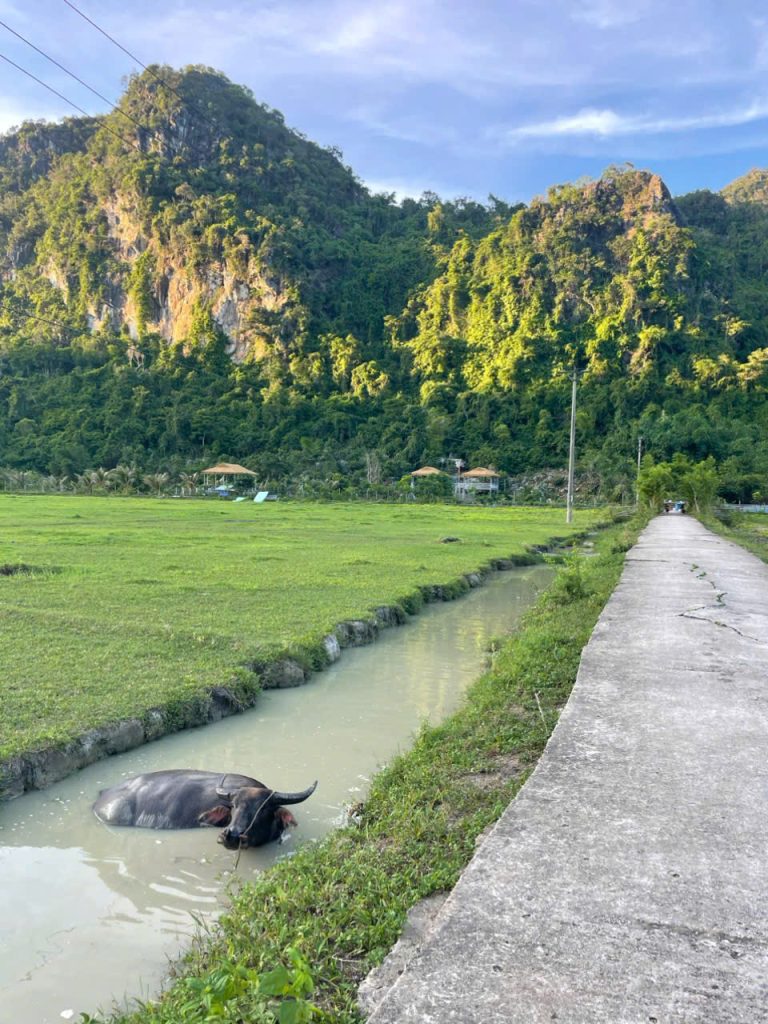
Cat Ba is the largest island in the Ha Long Bay–Cat Ba Archipelago World Heritage area, and the quiet way into the same limestone seascape that Ha Long is famous for. It has a national park, a bay with roughly 400 islands and 139 small beaches, a village no road reaches, and one of the rarest primates on earth. This guide covers what first-timers actually need: when to come, how to get here from Hanoi, Hai Phong, Ha Long and Ninh Binh, where to base yourself, what to eat, what to see, and the questions we answer for guests every week.
Cat Ba at a glance
| Where | Cat Hai Special Zone, Hai Phong, northern Vietnam — about 30 km from Hai Phong city, 3–3.5 hours from Hanoi |
| Size | Main island about 144 km²; 388 islands across the archipelago |
| Status | UNESCO World Heritage (Ha Long Bay–Cat Ba Archipelago, inscribed 16 September 2023); Biosphere Reserve since 2004 |
| National park | Founded 1986; over 17,360 ha of forest and sea; home to more than 90 Cat Ba langurs |
| Best months | October–November and March–April; May–September is warm, busy and stormier |
| From Hanoi | 3–3.5 hours by bus and ferry via Dong Bai pier |
| Fixed fees | Lan Ha Bay ticket 120,000 VND adult / 60,000 VND child; national park main gate 160,000 VND adult / 80,000 VND child |
In this guide: Cat Ba at a glance · When to visit · How to get there · Itineraries · Where to stay · What to eat · Places to see · What to bring home · Practical tips · FAQ
Cat Ba Island at a glance
Cat Ba sits on the eastern edge of Hai Phong, where the Red River delta meets the limestone islands of the Gulf of Tonkin. Since 1 July 2025 the whole archipelago has been administered as the Cat Hai Special Zone — the old “Cat Hai district” no longer exists — so you will see both names on signs for a while. The main island is roughly 144 km², and the archipelago counts 388 islands and islets between Cat Ba and the outlying Long Chau group.
Two things define the place. The first is Cat Ba National Park, established in 1986 and now covering more than 17,360 hectares of forest and sea, with 1,595 plant species, over 1,900 land animal species and the last wild population of the Cat Ba langur — around 40 animals in the early 2000s, more than 90 by late 2024. The second is Lan Ha Bay, the stretch of water on the island’s eastern side: over 7,000 hectares, around 400 islands, 139 pockets of sand, and a fraction of the boat traffic you will find in Ha Long proper. In September 2023 UNESCO extended the Ha Long Bay listing to include the Cat Ba archipelago, which is why the two bays are now one World Heritage site.
Local tradition offers two stories for the name. One says the bodies of two (some say three) women washed ashore and were honoured at a shrine called Mieu Cac Ba, which softened over time into Cat Ba. The other places the name in the 13th century, when Tran Hung Dao’s campaigns against the Mongols used these islands as a rear base run by women — the “Islands of the Ladies” — while the men fought from the Quang Ninh side, which still has Cua Ong, the “Gate of the Gentlemen”. Neither can be proved, but a small island called Cat Ong does sit in Lan Ha Bay.

When to visit Cat Ba
Cat Ba has a proper northern Vietnamese climate: hot, wet summers and cool, misty winters. Hai Phong records around 116 rainy days a year, most of them between May and September. The best months are the ones in between.
Peak season: May to September
Sea temperatures of 28–30°C, long days and the most boats on the water. It is also typhoon season. Storm warnings close the bay to all boats — sometimes for a day, occasionally for three — and a good operator will tell you before you travel rather than on the dock. Book two to three days ahead in June, July and August; Vietnamese holidays fill the island quickly.
Shoulder season: October–November and March–April
October and November are the sweet spot: warm water, clear air, thinner crowds. March and April are warming up and often misty in the mornings, which photographers tend to love. If you can choose, choose these. Our month-by-month breakdown is in the best time to visit Cat Ba guide.
Winter: December to February
Cooler — 15–20°C on many days, water around 18–21°C — with a low grey sky that sits on the karsts. Very few people swim. Trekking, cycling and the village are at their best, the bay is empty, and the light on a clear winter afternoon is extraordinary. See what Cat Ba is really like in winter before deciding.
| Months | Sea | Verdict |
|---|---|---|
| May–Sep | 28–30°C | Warm and busy; afternoon storms, occasional bay closures |
| Oct–Nov | 25–27°C | Best of the year — warm water, clear air, no crowds |
| Dec–Feb | 18–21°C | Cool and misty; walking and village weather, not swimming weather |
| Mar–Apr | 21–25°C | Warming up; morning mist, good light |
How to get to Cat Ba Island
The route changed in 2026: the old Got pier closed to tourist traffic, and everything from the Hai Phong side now leaves from Dong Bai pier, about 20 km east of the city, crossing to Cai Vieng wharf on Cat Ba. Whichever direction you come from, you end up on one of three approaches — the Dong Bai ferry, the Tuan Chau ferry from the Ha Long side, or the water itself.
From Hanoi
The simplest option is a door-to-door bus that collects you in the Old Quarter, runs the expressway to Hai Phong and connects to the ferry or speedboat at Dong Bai — about 3 to 3.5 hours in total, with several departures a morning. A private car does the same in around 2.5 hours to the pier and suits families with luggage. The car ferry takes about 15 minutes and runs roughly every half hour; the passenger speedboat does it in under ten. Full detail, including the fare bands and what to do if you miss a connection, is in our Hanoi to Cat Ba guide.
From Hai Phong
If you arrive by train or fly into Cat Bi airport, it is a 25–30 minute taxi to Dong Bai pier, then the crossing. Cat Bi’s second terminal, due around 2027, will make flying in far more practical than it is today.
From Ha Long
Ferries cross from Tuan Chau to Gia Luan pier in the north of Cat Ba. Two newer options exist as well. The Cat Ba cable car carries foot passengers over the water from the Cat Hai side and skips the ferry queue, though it stops in high wind. And since 20 April 2026, licensed cross-bay routes let an overnight cruise start in Ha Long Bay and finish in Lan Ha Bay — some itineraries stop at the entrance to our valley. Our take on both, in short, is that the cable car is a convenience and the cross-bay cruise is a genuinely different trip.
From Ninh Binh
Direct buses link Tam Coc and Ninh Binh city with Cat Ba via Hai Phong, and the Ninh Binh–Hai Phong expressway opening through 2026 is shortening the drive. Budget four to six hours door to door. The Ninh Binh to Cat Ba guide compares the options.
Reaching Viet Hai village
Viet Hai is on the far side of the island and no road reaches it. From Cat Ba town you go to Ben Beo harbour, then a speedboat across Lan Ha Bay — about 15 minutes — then an electric cart along a flat lane into the valley. Two state charges apply and they are the same for everyone: the Lan Ha Bay ticket, 120,000 VND per adult, and the cart, 50,000 VND per person. Children under six or under 1.2 m ride the bay free. The other way in is on foot through the national park, four to five hours over the ridge, with your bags sent ahead by boat. Every route is compared in how to get to Viet Hai village.
Make the transfer the trip
Most guests skip the direct crossing and arrive on a full-day Lan Ha Bay boat tour that kayaks and swims its way across the bay and drops them at the village pier in the afternoon. Or take the whole thing off your plate: our transfer service covers Hanoi hotel to village door, tickets included.
Suggested Cat Ba itineraries
The mistake most visitors make is treating Cat Ba as a day trip from Hanoi. The bay needs a day, the park needs half a day, and the village only reveals itself after the day boats have gone. Here is how the time actually divides.
One day
Arrive from Hanoi by mid-morning, go straight to Ben Beo and spend the afternoon on the water, sleep in Cat Ba town. You will see the bay and nothing else. If one day is truly all you have, a full-day boat trip with kayaking and swimming is the best use of it.
Two days, one night
This is the trip we would build for almost anyone. Hanoi to Ben Beo, a full day on Lan Ha Bay by boat and kayak, then the boat lands you at Viet Hai for the night: family dinner at one long table, the valley going quiet, and a morning of cycling or a short forest walk before the speedboat out. Our 2 Days in Viet Hai package runs exactly this, Hanoi to Hanoi, with everything included.
Three days
Add a night on the water. The 3-day cruise and homestay combines an overnight cruise on Lan Ha Bay, a cooking class, a night in the village and the Navy Peak hike — the 259 m summit above the valley that once carried a wartime radar station. More combinations, including a five-day version, are in the Cat Ba itinerary guide.

Getting here is the part most guests worry about. Tell us your arrival city and date and we will put the whole chain together — bus, boat and the cart from the pier — and meet you at Viet Hai. See how the transfer works, or just send us the dates.
Where to stay on Cat Ba
Cat Ba town
The harbour town has the restaurants, the nightlife, the ATMs and most of the hotels, from backpacker dorms to resort-style places above the Cat Co beaches. In 2026 it also has a large reclamation and construction project along the seafront, which has changed the feel of the town and some of the beaches — we explain what that means for your booking in Cat Ba construction 2026: where to stay. Stay in town if you want choice and convenience and are happy to take a boat to find quiet.
Viet Hai village
Viet Hai is the other answer. It is a farming valley of 87 households and about 295 people inside the national park, with no road out, mains electricity only since 16 August 2009, and — since June 2025 — official recognition as Hai Phong’s 13th community tourism site. Around 90% of its visitors are international, and most of them come for forty minutes on a day boat and leave. The valley is best in the evening and early morning, which is exactly what day-trippers never see.
Lan Homestay is our family’s place here: 15 rooms — garden bungalows and mountain-view rooms, each with a private bathroom and hot water — breakfast included, bicycles for guests, one long dinner table, and a team that arranges boats, treks and transfers before you have finished your coffee. Check-in runs from 11:30 to 13:00; small pets by arrangement — tell us when you book and bring your dog’s own bed or crate. The full comparison is in where to stay on Cat Ba: town or village.

What to eat on Cat Ba
Cat Ba eats from the sea. In town and along the harbour you will find grilled squid, steamed clams, sea snails, mantis shrimp and, in season, sea urchin. Two products from the wider archipelago are worth knowing. Cat Hai fish sauce — made on neighbouring Cat Hai island, where the Van Van brand started in the early 20th century and some 40 producers were working by the 1930s — is fermented for over two years and is the region’s best-known export. Cat Ba forest honey is newer: beekeeping here only took off in the 1990s, but the bees forage on hundreds of flowering species in the primary forest and the honey earned a “Cat Ba Xanh” certification in 2020. In winter, look for the thin-skinned Gia Luan oranges from the village next to ours.
In Viet Hai the food is Northern farmhouse cooking plus what the bay gives: free-range chicken with ginger, fish soup, crisp-fried dried fish, garden greens, and seafood hotpot or barbecue on request with a day’s notice. Dinner at Lan Homestay is served at one table and everyone staying that night eats together. We describe a typical evening in what to eat in Viet Hai village.
Places to see on Cat Ba
Lan Ha Bay
The reason most people come. Over 7,000 hectares, around 400 islands and 139 small beaches, admitted to the Most Beautiful Bays in the World club in January 2020. The best way to see it is from a kayak: through the Light and Dark caves into enclosed lagoons, past floating fish farms, and onto beaches that vanish at high tide. A full-day Lan Ha Bay boat tour from the village side reaches water the town boats never get to; on the darkest nights of the month, sunset and night kayaking paddles into bioluminescent plankton. First time in a kayak? Start with our Lan Ha Bay kayaking guide and the two-minute boat safety check. How the bay compares with its famous neighbour is in Lan Ha Bay vs Ha Long Bay.
Cat Ba National Park
Founded in 1986, the park covers more than 17,360 hectares and holds around 1,045 hectares of primary forest. The classic short walk climbs Ngu Lam peak (220 m) through the Kim Giao forest — about 1 hour 45 minutes return. The long walk crosses the island to Viet Hai. Entry is charged by route: 160,000 VND adult / 80,000 VND child at the main gate; 120,000 VND on the Kim Giao–Ngu Lam–Trung Trang route; 80,000 VND on the Ninh Tiep–Tien Duc cave route on the village side and on the Phu Long mangrove route. Trail detail is in the Cat Ba National Park hiking guide, and the trek across the park to Viet Hai has the full route. Expect macaques on the trails; the langur lives on coastal limestone cliffs and is seen from the water, if at all — see where to look for the Cat Ba langur.
Viet Hai village
Often described as an ancient fishing village; it is neither. The valley was cleared for rice around 1930 by two landowners from Hoanh Bo and ten tenant farmers, the name Viet Hai dates only from 1959, and the people have always been farmers. What is old is the valley itself: caves within the village boundary hold traces of people who lived here roughly 6,500 years ago. Cycle the flat valley road, walk to the fish stream where small fish nibble your feet (best July–September), or climb Navy Peak for the 360° view. Read Viet Hai Village: the valley no road reaches for the full story, and one day in Viet Hai for an hour-by-hour plan.
Cai Beo floating village
About 1.5 km south-east of Cat Ba town, Cai Beo is both a working floating settlement and one of Vietnam’s most important prehistoric sites: discovered by the French archaeologist Madeleine Colani in 1938, excavations since 1973 have found three cultural layers going back some 7,000 years, and it was listed as a national relic in 2009. The fish-farm rafts have been consolidated in recent years — far fewer than a decade ago — and most bay boats pass through on the way out.
Hospital Cave
Built between 1963 and 1965 by soldiers and islanders, this three-storey concrete hospital hidden inside a mountain about 13 km from town treated wounded during the American war for roughly a decade. It has more than a dozen rooms, including an operating theatre and a cinema. Twenty minutes with a local guide is enough, and it pairs naturally with the national park on a road day.
Beaches
The town beaches — Cat Co 1, 2 and 3 — are linked by a cliff path and are swimmable, but they are close to the construction and busy in summer. The better sand is in the bay: small coves at the foot of limestone islands with no facilities and often nobody on them, reached by boat or kayak. Many disappear at high tide, so timing matters. Cannon Fort, on the 177 m hill above the town beaches, is the classic viewpoint; access has been unreliable recently, so check locally before climbing.
What to bring home
A bottle of Cat Hai fish sauce, a jar of Cat Ba forest honey, dried squid or shrimp from the harbour market, and, in winter, a bag of Gia Luan oranges, which local elders say were once sent to the royal court and which lose their flavour when grown anywhere else. Skip the coral and shell souvenirs; the bay has lost enough.
Practical tips
- Cash. Cat Ba town has ATMs; Viet Hai has none, and many small restaurants and boat operators cannot take international cards. Withdraw before you cross.
- Signal. Coverage is good in town and patchy in the valley. Wi-Fi works at the homestay.
- Weather. Boats do not sail under a storm warning. Build a spare half-day into summer trips.
- Plastic. The bay collects it. Bring a bottle you can refill and take your rubbish off the beaches.
- Packing. Swimwear, reef-safe sunscreen, shoes you can swim in, a light rain layer. Our Cat Ba packing list has the rest.
- Prices. Bay and park tickets are fixed by the city; boat and room rates move with the season. If someone quotes a “tour fee” several times the ticket price, walk on — see Cat Ba scams and overcharging.
Frequently asked questions about Cat Ba
Answered by the Lan family in Viet Hai — the people who run the boats, cook the dinner and pick you up at the pier.
Is Cat Ba better than Ha Long Bay?
Same limestone, same water, far fewer boats. Since 2023 they are one World Heritage site. Ha Long has the famous name and the big cruise fleet; Cat Ba has the national park, the village and a bay you can kayak in something close to silence. For most independent travellers Cat Ba is the better base.
How many days do I need on Cat Ba?
Two days and one night is the minimum that makes sense: one full day on Lan Ha Bay and one night in Viet Hai village. Three days adds a night on the water or a proper trek. A single day from Hanoi shows you the bay and nothing else.
Is Cat Ba suitable for children and older travellers?
Yes. The bay boats involve no walking, the valley is flat enough for gentle cycling, and the homestay has ground-floor bungalows. Only the ridge trek and Navy Peak are demanding, and both are optional. Children under six ride the bay free.
Can I visit Cat Ba independently, or do I need a tour?
You can do it all independently. The one thing worth arranging in advance is the boat crossing to Viet Hai, because Ben Beo has no ticket office and no timetable — boats are arranged, not scheduled. Everything else can be decided once you arrive.
Is a Lan Ha Bay boat tour cheaper booked on the island?
Not reliably. Prices on the dock depend on who is free and how the negotiation goes. Fixed state fees — 120,000 VND for the bay, 50,000 VND for the cart — are the same everywhere; the boat itself is priced by season and group size, and booking direct with a local family avoids the middleman margin without the dock haggling.
Are the boats safe?
Rules on inspections and sailing in bad weather tightened across northern Vietnam after 2025. Look for life jackets you can reach, an operator who cancels when there is a storm warning, and a boat that is not overloaded. Our boat safety guide is a two-minute check you can do before boarding.
Is there an ATM in Viet Hai village?
No. Withdraw cash in Cat Ba town before crossing. At the homestay we accept VND, USD and EUR; cards carry a 3% fee.
Do I need a visa for Vietnam?
It depends on your passport. Many European passports currently enter visa-free for up to 45 days under exemptions that run into 2028; most others use the 90-day e-visa applied for online. Always confirm on the official government portal before flying.
Planning a trip to Cat Ba?
Tell us your dates, where you are starting from and how many of you there are. We will lay out the route, the boat day and the night in the village with current prices, and arrange whichever parts you want handled. WhatsApp +84 363 934 325 or send a message here — we answer in English, usually within the hour.
Read next
- Lan Ha Bay: the complete travel guide
- Things to do on Cat Ba Island
- 2 Days in Viet Hai — our signature trip