
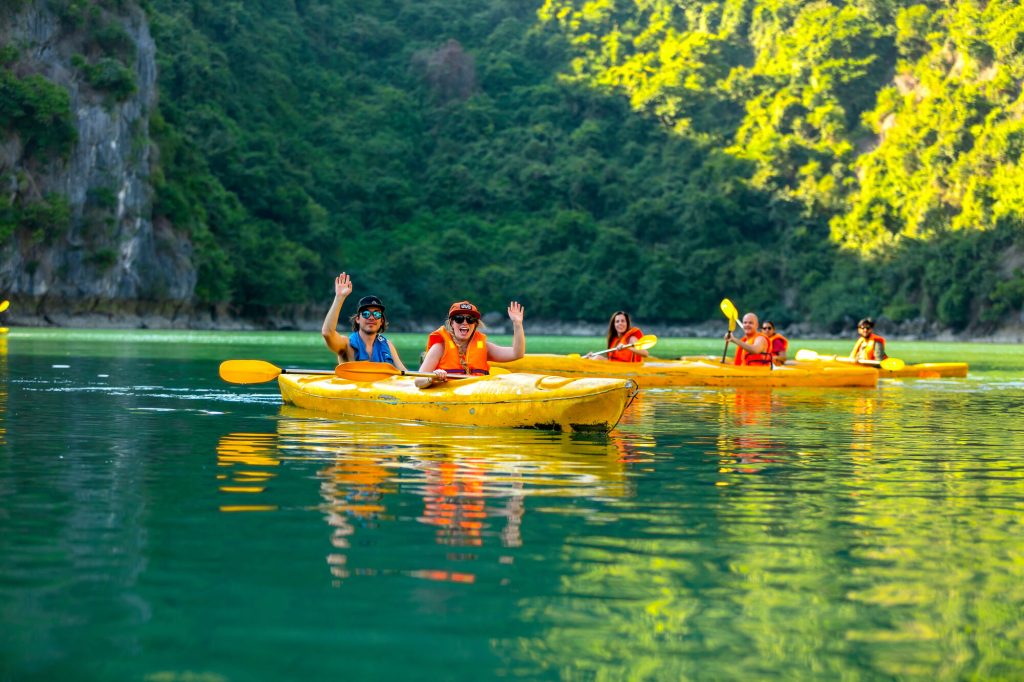
Lan Ha Bay has around 400 islands and 139 small beaches spread over more than 7,000 hectares, and six places account for most of what is worth a stop: Cai Beo, Monkey Island, Bright and Dark cave, Ba Trai Dao, the floating fish farms and Viet Hai village. We run boats from the village side of the bay, so we see all of them most weeks. This guide says what each one actually is, how long it deserves, and which to skip if your day is short.
| The bay | Over 7,000 ha, around 400 islands, 139 small beaches; Most Beautiful Bays in the World club since 26 January 2020; World Heritage (Ha Long Bay–Cat Ba Archipelago) since 16 September 2023 |
| Bay ticket | 120,000 VND adult / 60,000 VND child; free under 6 or under 1.2 m — fixed by the city, the same on every boat |
| Cai Beo | Prehistoric site found in 1938, layers to about 7,000 years, national relic 2009; 1.5 km south-east of Cat Ba town |
| Monkey Island | Cat Dua island: beach, macaques, short viewpoint trail |
| Bright and Dark cave | Kayak-only tunnel into an enclosed lagoon; the busiest spot in the bay by late morning |
| Viet Hai village | 87 households, about 295 people; speedboat from Ben Beo about 15 minutes; electric cart to the village 50,000 VND per person |
Which Lan Ha Bay attractions are worth the boat time?
Every boat in the bay sells a version of the same list. The difference is the order, the time of day and how long you sit at each stop. Here is the honest version, with the time we think each place earns.
| Place | What it is | Time it deserves | Best for |
|---|---|---|---|
| Cai Beo floating village | Working fish farms above a 7,000-year-old settlement site | 20 min, passed on the way out | History, photographs of the rafts |
| Monkey Island (Cat Dua) | Beach with a troop of macaques and a viewpoint trail | 45–60 min | Swimming, a short climb |
| Bright and Dark cave | Rock tunnel into a closed lagoon | 45 min by kayak | Kayaking, first-timers included |
| Ba Trai Dao beach | Three small coves under limestone cliffs | 30–60 min, tide permitting | Quiet swimming |
| Floating fish farms | Family rafts with pens of grouper and cobia | 20–30 min, often the lunch stop | Seafood, how the bay earns a living |
| Viet Hai village | Farming valley inside the national park, no road out | An afternoon — better, a night | Cycling, the evening the day boats never see |
Cai Beo: the floating village with 7,000 years underneath it
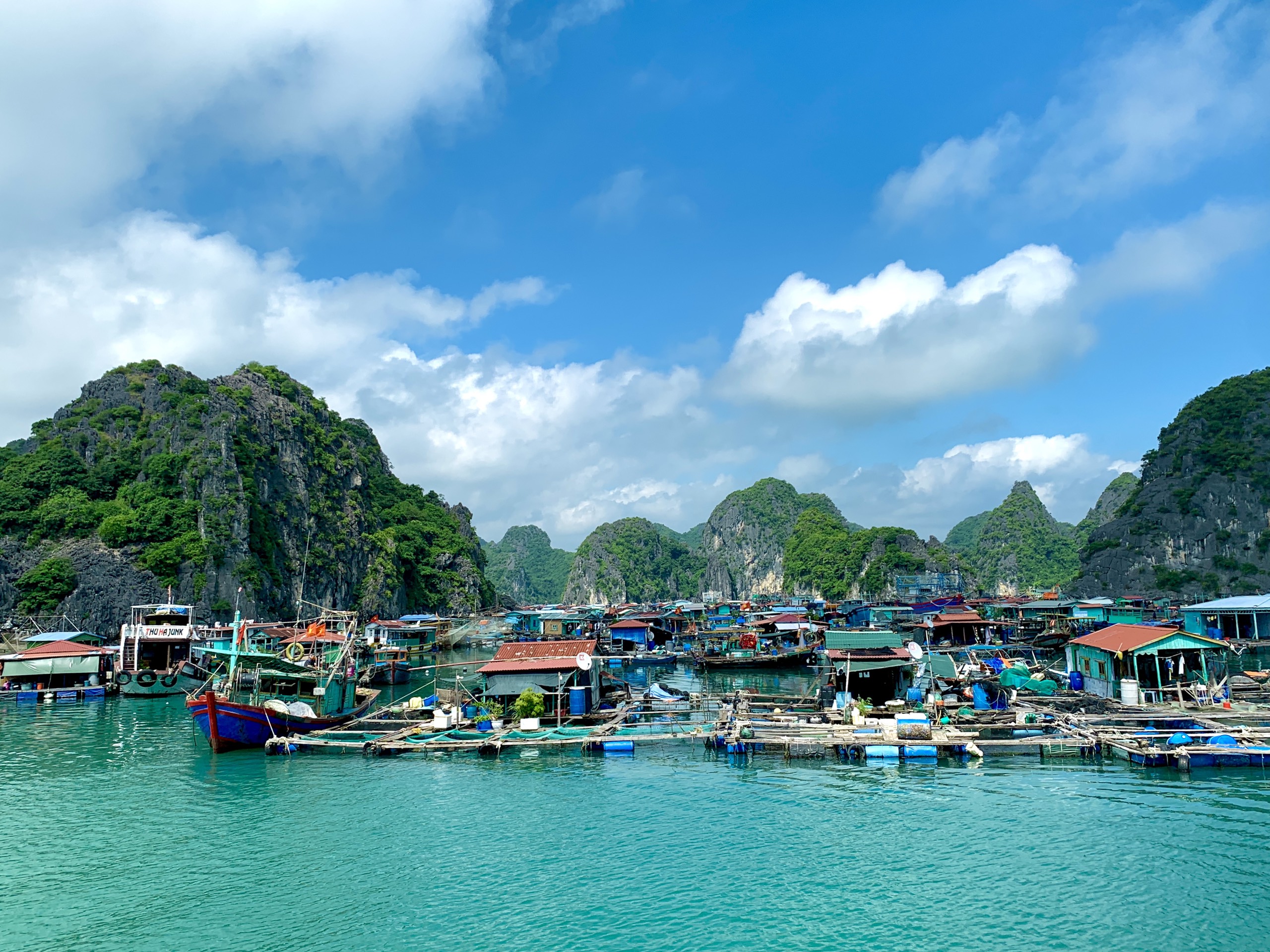
Cai Beo sits about 1.5 km south-east of Cat Ba town, and every boat leaving Ben Beo harbour passes through it. What you see is a working settlement of fish-farm rafts; what you cannot see is why archaeologists care. The French archaeologist Madeleine Colani identified the site in 1938. Excavations in 1973, 1981, 1986 and 2006 found three cultural layers reaching back roughly 7,000 years — stone axes, grinding stones, pottery, shell middens — on a site of about 18,000 m². It was listed as a national relic in 2009 and is regarded as the largest prehistoric coastal fishing settlement found in Vietnam.
The rafts have thinned. Hai Phong consolidated the bay’s fish farms into two planned zones, at Ben Beo and Gia Luan, and the number of cages fell by roughly three quarters. The view is emptier than in photographs from a decade ago. Ask your boat to slow rather than stop; the better raft visit comes later in the day.
Monkey Island (Cat Dua): beach, macaques and a viewpoint
Cat Dua island, known to everyone as Monkey Island, has the bay’s best-known beach and a troop of wild macaques that has learned where tourists keep their snacks. The beach is good for swimming, and a short, steep trail behind it climbs to a viewpoint over the surrounding islands; allow 20 minutes up and mind the rock, which is sharp and slippery in wet season.
Two things we tell every guest. Keep food in a closed bag and do not hand-feed the monkeys, however good the photograph; a macaque bite means a hospital visit. And these are macaques, not the Cat Ba langur. The langur — more than 90 remained at the last count, in late 2024 — lives on remote coastal cliffs and is seen from the water, if at all. Read where to look for the Cat Ba langur before you believe a boat that promises one.
Bright and Dark cave (Hang Sang – Hang Toi): the kayak everyone should do
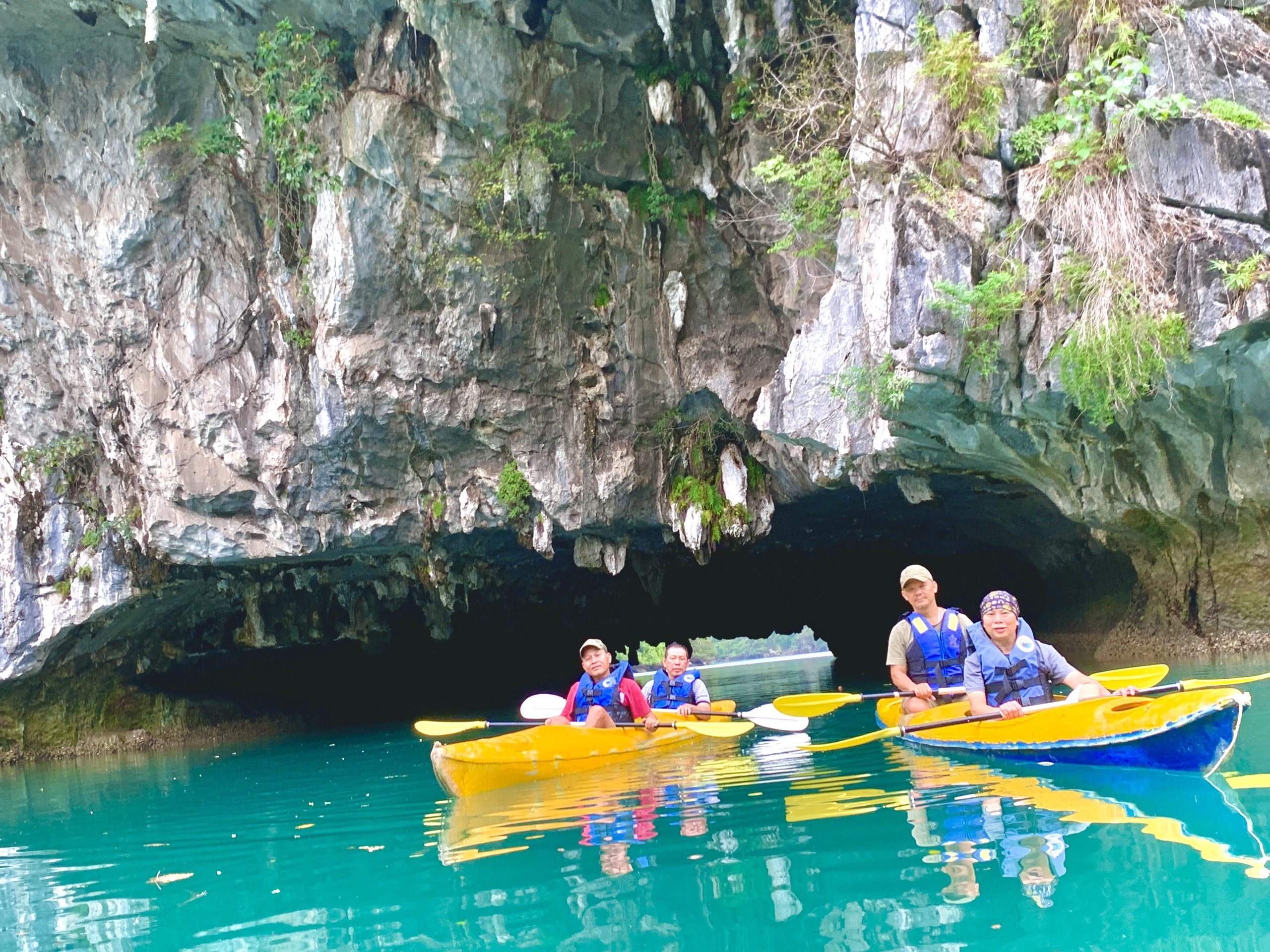
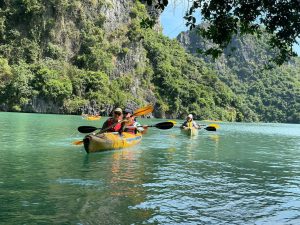
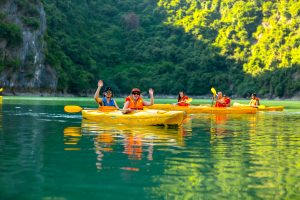
This is the stop the bay is known for, and it deserves the reputation. A low rock tunnel — about 70 m long, low enough that you duck at high tide — leads from the open bay into an enclosed lagoon ringed by limestone walls. It is kayak-only; the tour boat waits outside. The paddling is flat and short, so it works for people who have never sat in a kayak.
The catch is timing. Boats from Cat Ba town all arrive between late morning and early afternoon, and the lagoon fills with kayaks. From the village side we reach it earlier or later than the town fleet, which is the single biggest reason to start a bay day from Viet Hai rather than the harbour.
Our full-day Lan Ha Bay boat tour strings Bright and Dark cave, Ba Trai Dao, a swim stop and a family fish raft into one day with lunch on board, timed to miss the town boats where we can. For the bay after the boats have gone, sunset and night kayaking paddles out from the village pier; on the darkest nights of the month the water lights up with bioluminescent plankton. Rates move with the season and group size — ask us for the current one.
Ba Trai Dao: three coves under the cliffs
Ba Trai Dao, “Three Peaches”, is a set of three small sandy coves at the foot of three limestone islets, with a local legend attached to the name that every guide tells differently. It is the quietest swimming in the bay because it is boat-only and because the sand is largely under water for part of the day. Ask your skipper about the tide before you promise the children a beach: on a good afternoon you can have a cove to yourselves, on a bad one there is a metre of rock to sit on. No facilities, little shade, nowhere to buy water.
The floating fish farms, and the one we are proudest of
Most of the bay’s income still comes from the rafts: timber and plastic platforms with net pens underneath, a family house in the middle, a dog on the roof. A raft visit is usually where lunch happens — you point at the fish, it is cooked on board — and it is the most direct way to see how people here make a living.
The raft at the mouth of our own valley is a different kind. The Northern Centre for Marine Fish Breeding and Research moved its cage site to the Viet Hai estuary in 2003, according to its own reports, because the water suited the species it conserves — grouper, cobia and yellowtail among them — and it has recently reported Vietnam’s first captive breeding of yellowtail. It is a research station, not a show; visits depend on the staff, and we can ask on the day.
Viet Hai: the stop most boats only glance at
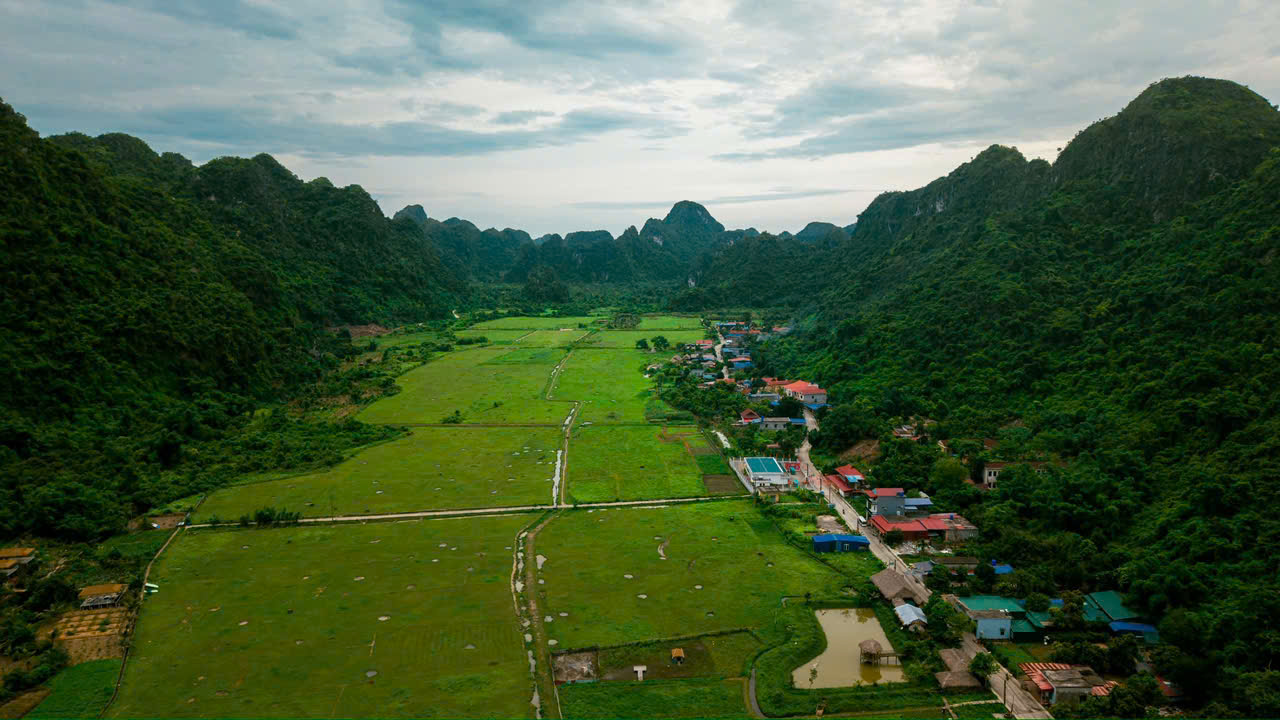
Our village is the last stop on many day itineraries and the one visitors get least from. Viet Hai is a farming valley inside Cat Ba National Park, cleared for rice around 1930 and home today to 87 households and about 295 people. No road links it to the rest of Cat Ba — not by regulation, but by geography; what vehicles exist stay in the valley. From the pier an electric cart (50,000 VND per person, about 10 minutes) runs through a tunnel in the hill to the houses, and the flat valley road is made for bicycles. In June 2025 Hai Phong recognised it as the city’s 13th community tourism site.
Day boats give the valley about forty minutes: enough to cycle the road and put your feet in the stream where small fish nibble them (most fish July–September), not enough to see why people stay. The valley empties when the boats leave, dinner is at one long table, and the morning is mist, rice fields and roosters. That is what our 2 Days in Viet Hai package is built around: a full day on the bay, then the night here, Hanoi to Hanoi. The valley itself is in our Viet Hai village guide.
Practical notes for a day on Lan Ha Bay
- Tickets. The bay ticket, 120,000 VND adult / 60,000 VND child, is a state fee and the same on every boat. Boat rates are not fixed and move with the season.
- Cash. Rafts, boats and the village take cash. Viet Hai has no ATM and many local places cannot take international cards; withdraw in Cat Ba town.
- Weather. A storm warning closes the bay to all boats, usually for a day, occasionally three. Build a spare half-day into summer trips, and run our two-minute boat safety check before boarding.
- Bring. Reef-safe sunscreen, shoes you can swim in, a dry bag for the kayak, a bottle you can refill. The bay collects plastic; take yours home.
Frequently asked questions about Lan Ha Bay attractions
Answered by the Lan family in Viet Hai — the people who run the boats, cook the dinner and pick you up at the pier.
Is Lan Ha Bay worth visiting compared with Ha Long Bay?
Yes — it is the same limestone and, since September 2023, the same World Heritage site, with a fraction of the boats. Ha Long has the famous name and the big cruise fleet; Lan Ha has Bright and Dark cave, beaches you can have to yourself and a village at the end of the day. Our comparison is in Lan Ha Bay vs Ha Long Bay.
How much time do I need to see the main attractions?
One full day on the water covers Cai Beo, Bright and Dark cave, a beach, a fish raft and the crossing to Viet Hai. To do the cave without the crowd, or see the bay at sunset, you need to sleep on the village side and add a second morning. Two days and one night is the trip we would build for almost anyone.
Can I visit Monkey Island and the caves with kids?
Yes. The boats involve no walking, the kayak into Bright and Dark cave is flat and short, and children under six or under 1.2 m ride the bay free. Keep food away from the macaques on Monkey Island, put small children in a double kayak with an adult, and check the tide before promising a beach.
When is the best time to visit Lan Ha Bay?
October and November, then March and April: warm water, clear air, thin crowds. May to September brings 28–30°C sea and the most boats, plus storm days when nothing sails. Winter water is 18–21°C and few people swim, but the cave, the rafts and the village are at their quietest.
How do I book a boat, and should I book on the dock?
Ben Beo has no ticket office and no timetable; boats are arranged, not scheduled, and the rate on the dock depends on who is free. Booking a day or two ahead with a local family fixes the boat, the route and the rate without the haggling. Message us with your dates and group size and we will confirm within the hour.
Is there an ATM in Viet Hai, and can I pay by card?
Cat Ba town has ATMs; Viet Hai has none, and many rafts, boats and small restaurants cannot take international cards. Withdraw enough for the bay ticket, lunch on the raft and the cart before you cross. At the homestay we accept VND, USD and EUR; cards carry a fee.
Planning a day on Lan Ha Bay?
Tell us your dates, how many of you there are and whether you would rather swim, paddle or eat. We will lay out the stops in the right order for the tide and the crowds, with current rates, and arrange the boat from either side of the bay. WhatsApp +84 363 934 325 or send a message here — we answer in English, usually within the hour.
Read next
- Lan Ha Bay: the complete travel guide
- Kayaking in Lan Ha Bay: a beginner’s guide
- One day in Viet Hai village, hour by hour
You may also like

Where to stay in Viet Hai
If this trip brings you into the village, the rooms and bungalows at Lan Homestay are a few minutes on foot from the centre: the garden bungalow (triple) works well for families, and the mountain-view double room for couples.
