
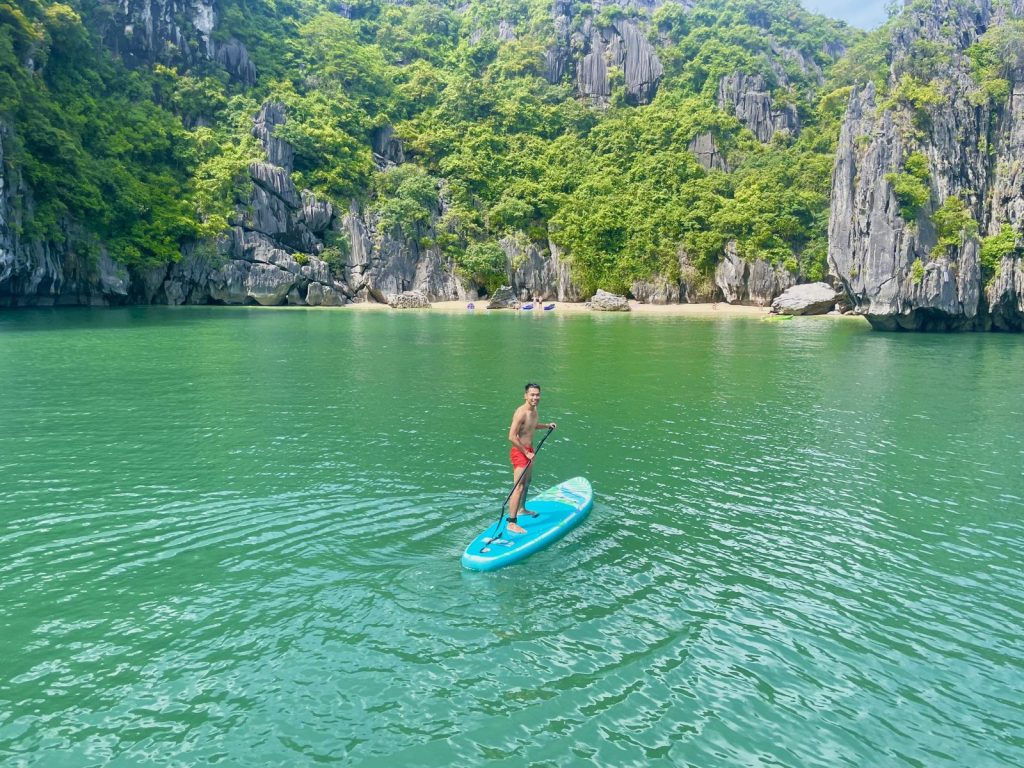
Yes, you can swim in Lan Ha Bay, and most day boats stop for it; but there are two things to know before you jump: jellyfish appear in the warm months, and how clear the water looks depends on the tide and on where the boat anchors. We live in Viet Hai and take guests onto the bay most days from April to November, so this is the honest version: when the swimming is good, when it is not, and how we pick the spot.
Swimming in Lan Ha Bay at a glance
| Can you swim? | Yes. Day boats and overnight cruises stop at sheltered coves and lagoons for a swim |
| Water temperature | Warm from May to October; cool but possible in April and November; cold December to March |
| Jellyfish | Present mainly May to September; mostly harmless stingers, occasional sharper ones. The boat crew checks the water before you go in |
| Water clarity | Clear green in the lagoons and outer coves at high tide; murkier near harbours, fish farms and after heavy rain |
| Is it clean? | Away from Ben Beo and the town it is clean enough that we swim with our own children. Near harbours we do not |
| Beaches | Small sand beaches at Ba Trai Dao and a few coves; Cat Ba town has Cat Co 1–3 |
| Lan Ha Bay ticket | 120,000 VND adults, 60,000 VND children |
Where the boat stops, and why it matters
Lan Ha Bay is not one piece of water. The stretch between Ben Beo harbour and the floating fish farms is a working port: boat traffic, fuel, nets, and the run-off from Cat Ba town after rain. Nobody swims there, and if a cheap boat offers a “swim stop” within sight of the harbour, say no. Twenty minutes further out, past the fish farms, the bay turns into hundreds of limestone islands with lagoons between them. That is where the swimming is: coves with no boats, water that is green and clear to a few metres, and a sand beach here and there. Our day boat anchors at one of three or four spots depending on wind and tide, and we move if the first one is cloudy that day.
So when people search whether Ha Long or Lan Ha is “dirty”, the honest answer is that both exist in the same bay. The harbour side is, the island side is not, and the difference is which boat you are on and how far it goes.
Jellyfish: when, what kind, and what to do
Jellyfish come into the bay with the warm water, roughly from May to September, and peak in the hottest weeks of June, July and August. Most of what you see are small, clear or milky jellies that give a mild sting, like a nettle, that fades in half an hour. A few times each summer there are larger ones with longer tentacles that sting harder, and the crew will not let anyone in the water when they see them. In April, October and November jellyfish are rare, which is one of the reasons we like the shoulder months for swimming.
What we do on the boat: before a swim stop the crew looks over the side for a couple of minutes; if there are jellies drifting, we move or skip the swim. A rash vest or a long-sleeved swim top covers most of the skin that gets stung. If you are stung, rinse with sea water, not fresh water, scrape off any tentacle with a card edge, and tell the crew; we carry vinegar and a cold pack on board. Serious reactions are very rare here, but if you know you are allergic to stings, tell us when you book and swim in a full suit or stay on deck.
| Month | Water | Jellyfish | Clarity | Our note |
|---|---|---|---|---|
| December – February | Cold, around 18–20°C | None | Often grey and misty | Nobody swims; boat and kayak trips still run (winter guide) |
| March | Cool | Rare | Improving | A few brave guests dip after kayaking |
| April | Cool to pleasant | Rare | Good on dry days | Swimming starts |
| May – June | Warm | Arriving, increasing | Good, haze on still days | Great swimming; crew checks for jellies |
| July – August | Very warm | Peak | Variable; cloudy after storms | Swim with a rash vest; typhoon closures possible |
| September | Warm | Declining | Good between storms | Storm season tail, watch the forecast |
| October | Warm, our favourite | Few | Best of the year | Long swims, clear coves |
| November | Cooling | Rare | Clear mornings | Short swims early in the month |

Why the water looks different from one day to the next
Three things change the colour of the bay. Tide: at high tide clean sea water fills the lagoons and the coves look their best; at low tide the shallows show silt and the water goes milky. Rain: a heavy storm washes mud off the islands and the bay can stay cloudy for a day or two afterwards, which is why we do not promise a clear swim in the week after a typhoon (see what happens in typhoon season). Plankton: in the hot months the water sometimes carries a green bloom in still weather, harmless but not pretty, and the same plankton is what glows at night on the bioluminescent kayak trips. None of these are pollution, and a good skipper knows which cove will be clear on a given tide.
Swimming safely from a boat
Most swim stops are from the boat into deep water, not from a beach, so a few plain rules. Wear the life jacket if you are not a strong swimmer; nobody on our boat minds. Stay within the area the crew points out, because the current between islands is stronger than it looks and tour boats pass through the channels. Do not climb the rocks without a guide; the limestone is sharp and the water under it is not always deep (see our page on deep water solo for how that is done properly). Keep children within arm’s reach and in a jacket. Our boat safety guide covers the boats themselves, including what a licensed boat looks like and why we do not use the cheap ones.
If you would rather swim from a beach
Lan Ha has a few small sand beaches that the boats visit, the best known at Ba Trai Dao (Three Peaches), three islets with a strip of sand that disappears at high tide. On Cat Ba itself the town beaches Cat Co 1, 2 and 3 are easy and lifeguarded in season, and we compare them in our beaches guide. Viet Hai has no beach; the village is in a valley behind the mountains, and the sea for us is a boat ride away (the rest of what the island offers is in things to do on Cat Ba). Guests who want sand every day usually split the stay between the town and the village.
For a quieter way onto the water, the kayak trips put you in the lagoons where the swimming is best, and many guests swim from the kayak rather than from the big boat.
How we run the swim stops
Our full-day Lan Ha Bay trip includes at least one swim stop in a cove away from the harbour, chosen on the day for tide and wind. The crew checks for jellyfish first, carries vinegar and life jackets, and moves the boat if the water is cloudy. From December to March we still run the trip for the scenery and kayaking but we tell you plainly that swimming is off. Rates move with the season and the size of the group, so message us with your dates.
Questions about swimming in Lan Ha Bay
Are there jellyfish in Lan Ha Bay?
Yes, in the warm months, mainly May to September with a peak in midsummer. Most are small and give a mild sting; the crew checks the water before each swim stop and skips it if they see larger ones. In October, November and April jellyfish are rare.
Is the water in Lan Ha Bay clean?
Away from Ben Beo harbour, the town and the fish farms, yes: the lagoons and outer coves are clear and we swim there with our own family. Near the harbour it is not, and that is where the “dirty” photos online come from. Clarity also drops for a day or two after heavy rain.
What month is best for swimming in Lan Ha Bay?
October: warm water, few jellyfish, the clearest coves of the year and the summer storms mostly over. May and early June are a close second. July and August are warm but have the most jellyfish and the storm risk.
Can children swim in Lan Ha Bay?
Yes, with a life jacket and an adult in the water with them. The swim stops are in deep water from the boat, so we fit jackets to every child before the stop. Our Cat Ba with kids page has more.
Anything else, send us a message and we will answer from the village.
Read next
- Cat Ba beaches guide
- Lan Ha Bay boat safety guide
- Kayaking in Lan Ha Bay for beginners
- Cat Ba in October and November
